Meshia Mambo
A coalition of international donors, channelling funds through the Migration Multi-Partner Trust Fund, has officially launched a flagship joint programme in Harare to safeguard thousands of unaccompanied children navigating one of southern Africa’s most perilous migration corridors.
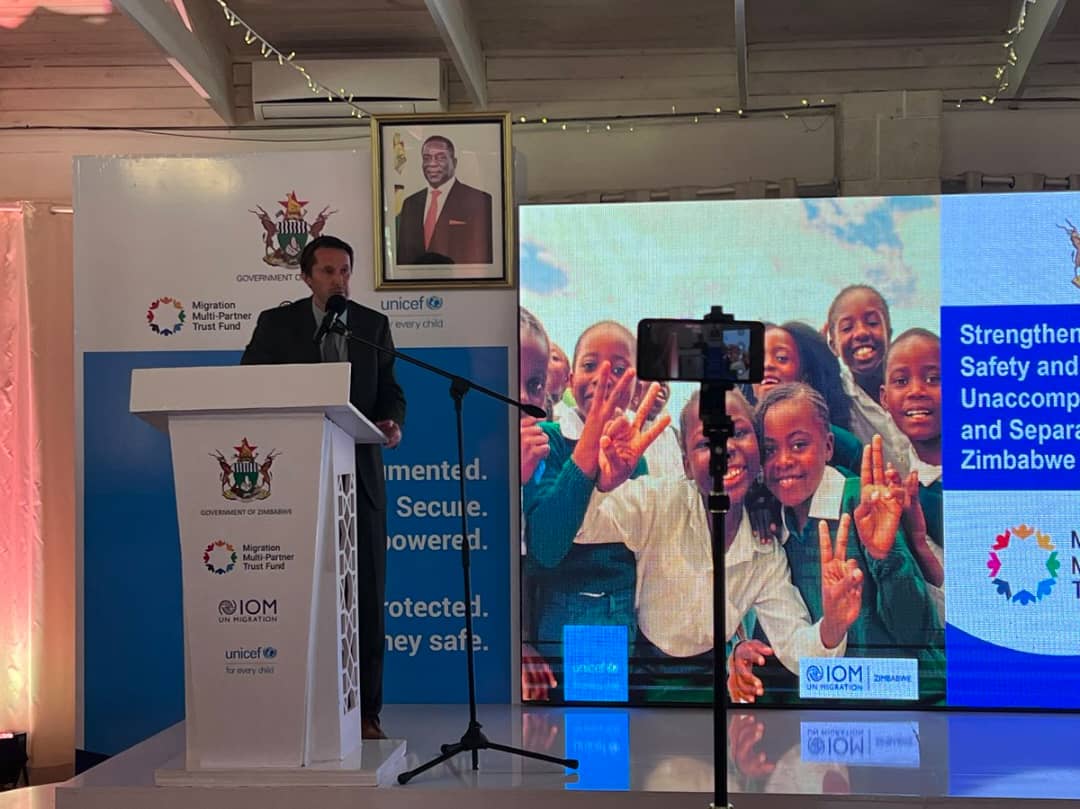
Sam Thompson, Head of Human Development and Inclusion at the British Embassy in Harare, represented the entire donor community at the launch of Strengthening the Safety and Well-being of Children on the Move in Zimbabwe — a joint programme implemented by IOM and UNICEF and backed by the Geneva-based Migration Multi-Partner Trust Fund (MPTF).
“There’s an increasing flow of children who are unaccompanied and who are travelling either from Zimbabwe but particularly through Zimbabwe as an irregular migration route,” Thompson told journalists at the event.
Zimbabwe sits at the heart of the Southern African migration corridor, and UNICEF Representative Etola Ekole described the country’s role as uniquely complex.
“Zimbabwe is a country of origin, it’s a country of transit, and it’s a country of destination for children on the move,” she said.
For Unaccompanied and Separated Children (UASC), the journey carries severe risks, including trafficking, exploitation, and a complete lack of legal identity documentation.
“If you imagine these young children who are alone, trying to work out where they should be going, protecting them from any traffickers, having these safe spaces is crucial,” Thompson said.
The programme will see the refurbishment and staffing of Reception and Support Centres at key border posts, Beitbridge, Plumtree, and Chirundu to provide immediate safe shelter, food, and psychosocial support to children upon arrival.
Ekole outlined the multi-layered strategy driving the initiative.
“We are sensitising, we are building institutions, we’re strengthening the social service workforce to be able to provide the necessary case management for undocumented children, and working with Home Affairs to ensure that we have alternatives to detention,” she explained.
She stressed that the programme is anchored on two non-negotiable pillars.
“It’s all about prevention of unsafe migration and it’s all about protection of the children who do migrate, that they have the right services and they are actually safe that’s the essence of the programme,” Ekole stated.
To address root causes, UNICEF is working alongside the Ministry of Education to keep children in school and with the Ministry of Public Service, Labour and Social Welfare on parental training programmes.
“When children are having to work, sometimes they have to go very far to work, but really children should be in school and they should be protected,” she said.
Beyond physical safety, the initiative addresses a critical gap in legal identity by collaborating with Zimbabwe’s Civil Registry to facilitate access to birth certificates for migrant and returned children.
Family reunification sits at the core of the programme’s mandate, with Thompson affirming the fund’s commitment to reconnecting children to their home families and supporting sustainable reintegration through education and livelihood linkages.
For Ekole, success has a very specific meaning.
“Rather than rounding children up and putting them in detention and sending them back off to some other place, it’s about what care they will need to receive and how you work on family tracing and reunification that’s what success is going to look like,” she said.
Thompson outlined how the donor community would measure the programme’s impact.
“You can look at the number of children reconnected to their families, the number supported through migration resource centres at Beitbridge, and then you can also look at the overall community response are they feeling better supported and able to support these children?” he said.
The programme runs for two years, a window Ekole described as tight but purposeful.
“We have a very short window, so we really need to collaborate to be able to meet the various objectives of the programme,” she said.
Thompson expressed confidence that the programme’s legacy would outlast its funding cycle.
“The way that we fund it means that hopefully there will be systems and structures in place which means that actually it can continue to work even after the funding ends,” he said.
Thompson concluded with an appeal for continued collective action, affirming that the donor community remains committed to ensuring that no child on the move is left without protection, documentation, or a safe place to call home.