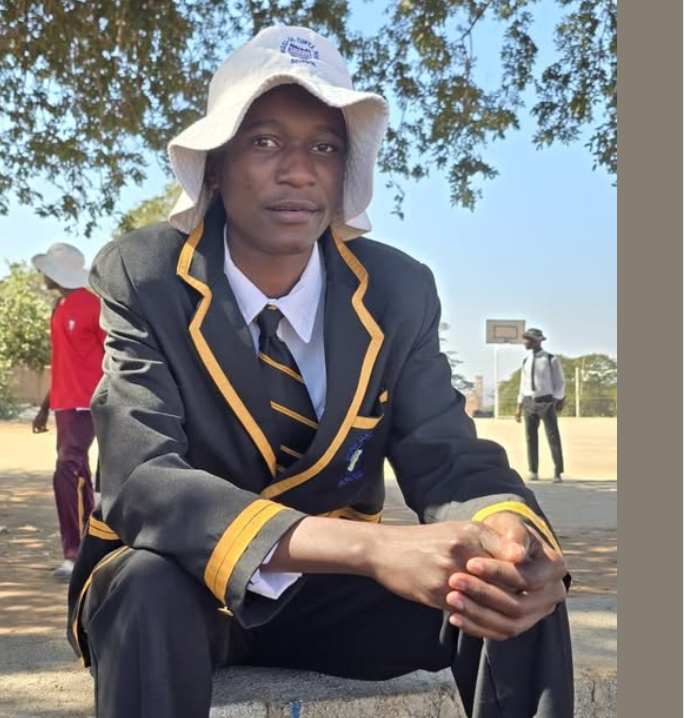
A Lower Sixth student, Takunda Makoni, from Mosi-Oa-Tunya High School, has developed a cybersecurity project that helps users of mobile financial services avoid being exposed to account theft through fake applications and fraudulent websites.
The project was developed as part of Takunda’s A-level studies and focuses on a major cybersecurity threat known as phishing.
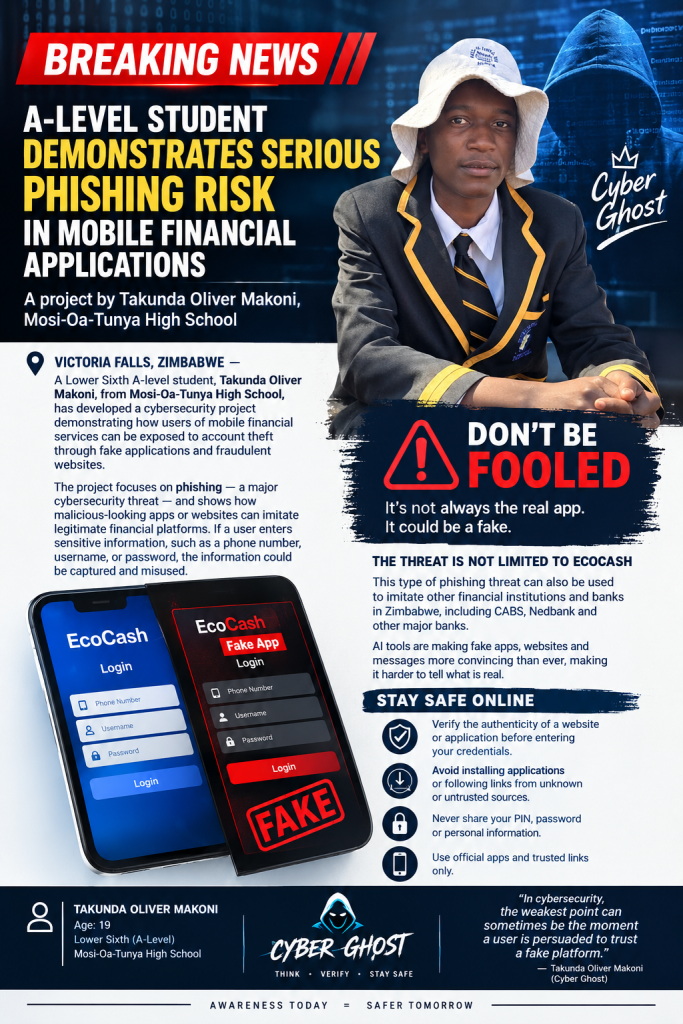
During testing of the system, authorised participants gave permission for their accounts and test credentials to be used in a controlled demonstration.
Takunda’s project further highlights the evolving nature of cybercrime in the age of artificial intelligence.
Takunda’s project demonstrates how a relatively simple social-engineering technique can create serious security risks for users of digital financial services.
The project is intended strictly for educational, authorized, and cybersecurity-awareness purposes, with testing conducted only where permission was provided.
The student hopes the project will encourage greater awareness of phishing attacks and the importance of protecting personal and financial credentials in an increasingly digital environment.
In an interview, he said he feels very happy and grateful about this achievement.
“Over the years, I have developed many websites and applications, but most of them have simply remained on my computer without getting the opportunity to be seen by the outside world.
“This particular innovation has given me an opportunity to showcase my talent and demonstrate what I am capable of doing.
“For me, this is more than just an achievement.
“It is a reminder that the time, effort, and persistence I have invested in learning technology are beginning to create opportunities for me.
“ It has motivated me to continue developing my skills and working on solutions that can have a positive impact on society.
“The innovation I am being recognised for is an application I developed to demonstrate and raise awareness about phishing attacks.
“My goal was not simply to create software, but to use technology to demonstrate a real cybersecurity problem and help people understand the importance of being careful and aware when using digital platforms.”
He is currently working on another major project, which he preferred not to reveal too many details about it at this stage.
“What I can say is that the project is focused on helping improve Zimbabwe’s education system, particularly by supporting disadvantaged and disabled students.
“I am hoping to find people who share the same vision and may be willing to work with me as I develop the project further.
“I believe that with the right support, young people can create solutions to some of the challenges facing our country.
“My biggest dream is to see an education system in Zimbabwe that leaves no one behind.
“I believe that every student has potential, but not every student demonstrates that potential in the same way.
“Some students perform very well academically and theoretically, while others are extremely talented when it comes to practical work, creativity, technology, engineering, art, or other skills.
“I would like to see an education system that identifies and develops different forms of talent instead of making students feel that they are unsuccessful simply because they do not perform well in traditional academic subjects.”
The young learner feels that students should also be given more opportunities to present their talents and showcase their innovations to the world.
“Zimbabwe has many talented young people, but sometimes their abilities remain hidden because they do not have the platforms, resources or opportunities to demonstrate what they can do.
“I believe education should prepare students for life beyond the classroom.
“When a student finishes school, they should leave with something valuable, whether it is academic knowledge, a practical skill, technical expertise, entrepreneurial ability, creativity or another talent that can help them build a meaningful future.
“My vision is simple: no student should leave school feeling that they have nothing to offer the world.
“I am currently doing A-Levels, where I am studying Pure Mathematics, Physics, and Software Engineering.
“I have a strong interest in technology and engineering, particularly software engineering, cybersecurity, electrical power engineering and electronics.
“I am still developing my skills and exploring where my abilities and interests will take me in the future.
“I want to use technology and engineering to solve real problems. I do not want to learn simply for the sake of getting qualifications.
“I want to build things that can make a difference.
“I want to continue developing software, exploring cybersecurity, learning engineering, and creating innovative solutions that can benefit people in Zimbabwe and, eventually, beyond Zimbabwe.
“One of the things I have learned from my journey is that young people should not underestimate themselves.
“Sometimes an idea starts as something small on a computer, but with persistence, support and the right opportunities, it can grow into something much bigger.”
His dream is to see people that young Zimbabweans have the ability to create, innovate and solve problems within their own communities.
“I would also like to sincerely thank Mr Dingani Mugande, who is now teaching at Inyathi High School. He played an important role in helping me reach this stage.
“When I was in the Arts class, Mr Mugande identified my potential to be good in sciences; he made a proposal to move into the Sciences class. It was not easy for that change to happen, but Mr Mugande supported the idea of me pursuing Sciences.
“I am extremely grateful to him because, if I had not moved into the Sciences class, my journey could have been very different.
“Today, I am doing A-Level Sciences, and that opportunity opened doors for me to explore areas such as software engineering, cybersecurity, physics, and engineering.
“Sometimes one person’s decision to believe in a young person’s potential can completely change that person’s future.
“For that, I will always be grateful to Mr Mugande.
“My message to other young people is that we should not be afraid to dream, create, and try new things.
“We may not always have all the resources we need, and our ideas may not always be understood immediately, but that should not stop us from learning and building.
“I want my work to demonstrate that we do not have to wait for someone from another country to come and solve every problem for us.
“Zimbabwean young people can identify problems in their communities, develop solutions, and showcase those solutions to the world.
“My ultimate vision is to contribute to a Zimbabwe where no one is left behind, and every young person has an opportunity to discover what they are capable of becoming.”