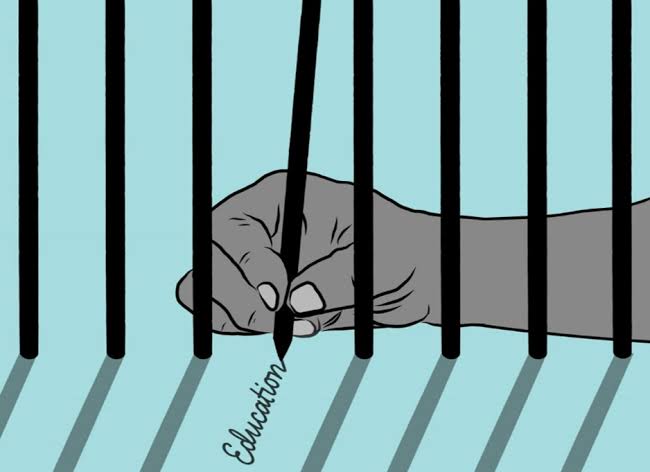
In a windowless room that could belong to any government building in Southern Africa, Kudzai Nyoka leans forward and says a sentence that should unsettle every policymaker in the region: “Most of the people I met inside weren’t hardened criminals.
They were undereducated people who ran out of options.”
It is not an excuse.
Nyoka is careful, almost insistent, about that distinction.
It is a diagnosis and one that Nyoka argues the region’s prison systems have consistently refused to treat.
The pattern nobody wants to name
Nyoka’s argument begins with observation, not theory, years spent watching who actually fills Southern Africa’s prison cells.
“Sit in any remand court and start counting,” Nyoka says.
“Count how many of the accused finished secondary school. Count how many can read a contract, understand an interest rate, calculate what a loan will actually cost them over five years.
The numbers will tell you everything policymakers pretend not to know.”
Nyoka’s contention is blunt: a significant share of the crimes that fill Southern African prisons — fraud born of financial illiteracy, violence born of poor conflict resolution skills, petty theft born of zero employable skills — are not moral failures so much as educational ones.
“Nobody is born knowing how to forge a document or plan a robbery,” Nyoka says.
“But nobody is born knowing how to read a payslip or negotiate a dispute without a fist either. Both are learned.
The tragedy is we only invest in teaching one of them after it’s too late, and only behind bars, if at all.”
A system built to warehouse, not to teach
This is where Nyoka’s critique turns from observation to indictment.
“We call them correctional facilities. Ask yourself honestly what are they correcting?”
Nyoka says.
“In most institutions I have had visibility into, education is an afterthought.
A pamphlet.
A once-a-week class taught by whoever is available, with no curriculum, no accreditation, no continuity.”
The consequence, Nyoka argues, is a revolving door dressed up as justice.
“You take someone who lacked the tools to survive legally, you remove their liberty for a number of years, and you give them back to society with the exact same gaps they walked in with, except now they also have a criminal record.
“We haven’t corrected anything. We’ve just paused the clock.”
The cost of doing nothing
Nyoka is quick to frame this not as a moral argument alone, but an economic and security one — the kind that should register with finance ministries as much as justice ministries. “Every reoffender is a receipt,” Nyoka says.
“Re-arrest, re-trial, re-incarceration — multiply the cost of a single prison bed over a repeat sentence, and compare that to the cost of a literacy programme or a trade certificate.
The maths embarrasses the current approach.” Recidivism, Nyoka argues, is not simply a moral failure of the individual; it is frequently a predictable outcome of releasing someone into the same conditions of poverty and low skill that led them inside in the first place.
“If you don’t change the inputs, don’t be surprised by the outputs,” Nyoka says.
What education actually repairs
Pressed on why education specifically rather than vocational training alone, or psychological counselling, Nyoka’s answer is layered.
“Literacy gives someone the ability to understand a contract before they sign it, to read a job application properly, to help their own child with homework without shame,” Nyoka explains. “Numeracy gives them the ability to manage money so they’re not vulnerable to the next loan shark or get-rich-quick scheme.
And beyond the practical, education restores dignity.
It tells a person: you are not just your worst decision.
You are someone capable of growth.” That psychological shift, Nyoka insists, is often the real turning point.
“A person who earns a certificate inside prison, even a basic one, starts to see themselves differently.
That self-image is often the first domino. Everything else, the discipline, the ambition to stay out, follows from that.”
Practical solutions: What reform could look like
Nyoka is careful not to leave the critique hanging without a roadmap, laying out a set of concrete, resource-conscious proposals aimed specifically at the realities of Southern African prison systems where budgets are tight, staff are stretched, and political will is inconsistent.
Mandatory baseline literacy and numeracy assessment on intake.
Every prisoner should be assessed for literacy and numeracy levels within the first weeks of incarceration, the same way health screenings are conducted.
“You cannot fix a gap you haven’t measured,” Nyoka says.
- Partner with existing Ministry of Education curricula, not parallel ones.
Rather than inventing prison-specific syllabi, Nyoka proposes formal partnerships so that inmates sit the same recognised national exams ZIMSEC-equivalent qualifications, for example that carry currency outside prison walls.
“A certificate that only means something inside the fence is worthless the day you walk out of it.”
- Vocational tracks tied to regional labour market data.
Trade skills welding, solar installation, agro-processing, tailoring, digital literacy should be selected based on actual regional demand, not whatever equipment happens to be donated.
“Teach someone a trade nobody’s hiring for, and you’ve just taught them a new way to fail.”
- Peer-teacher models to solve the staffing crisis.
With chronic shortages of qualified educators in correctional facilities, Nyoka suggests formally training literate, longer-serving inmates as certified peer tutors a model already piloted with some success in parts of the region.
“It costs almost nothing, and it gives the tutor a purpose too. Teaching is its own form of rehabilitation.” 5. Post-release education bridges, not cliffs.
Nyoka is emphatic that education cannot stop at the prison gate.
“Right now, someone finishes a course inside, and the moment they’re released, that support system vanishes. We need halfway structures community colleges, NGOs, employer partnerships — that pick up where the prison programme left off.”
- Involve the private sector directly.
Nyoka proposes tax incentives or public recognition schemes for regional businesses willing to both fund prison education programmes and commit to interviewing graduates. “Education without a pathway to employment is just a longer wait for the same disappointment.”
- Regional data-sharing and benchmarking among SADC states.
Finally, Nyoka calls for Southern African countries to compare notes rather than reinvent the wheel in isolation.
“Zambia, Zimbabwe, South Africa, Malawi, we’re all fighting the same fire separately. Imagine what we could learn if we actually compared what’s working.”
The line that sticks
As the conversation draws to a close, Nyoka offers a final reflection — one aimed less at policymakers and more at the public that funds and tolerates the current system.
“We keep asking why people reoffend, as if it’s a mystery.
It isn’t. We send people to prison uneducated, and we release them uneducated.
We didn’t rehabilitate them.
We just made them wait. Give a person an education, and for the first time, you give them an actual alternative to the life that put them there.”
For Nyoka, that is the real definition of correction, not concrete walls and counted years, but a mind equipped to choose differently the next time it’s tested.